Neutrino Ettore Majorana Observatory

UCL
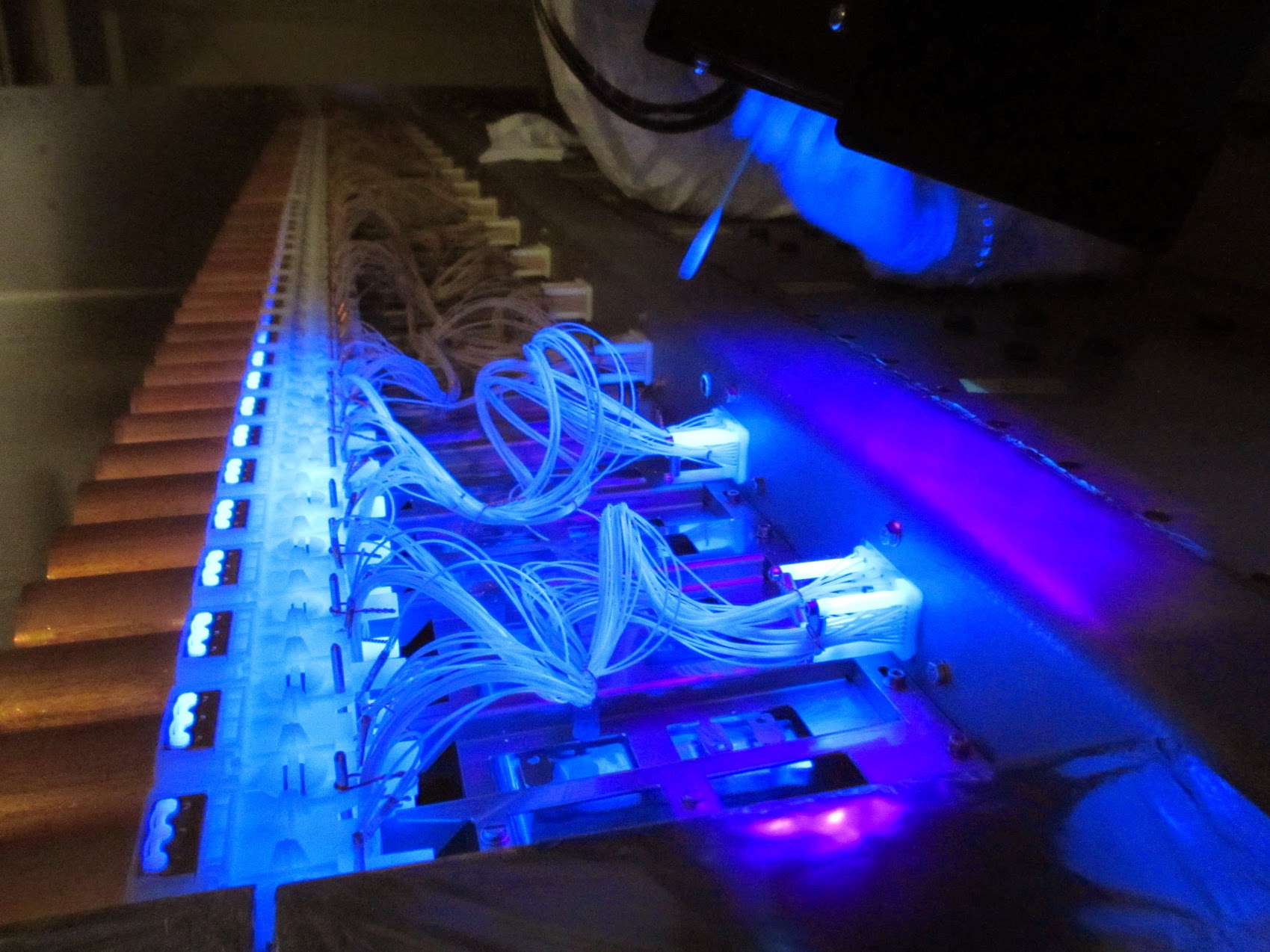
NEMO III detector

Valid HTML 4.01!
Valid CSS!

Introduction

For the NEMO/SuperNEMO Document Database at University of Texas (DocDB) click here.


Neutrinos are the second most abundant particles in the Universe. There are on average about 3 million of them in a cubic metre. They are among very few truly fundamental particles on which we build our Standard Model of particle physics. Yet, neutrinos are the least understood objects in particle physics.


In the Standard Model neutrinos are assumed to have exactly zero mass. However, now we have pretty solid evidence that this is actually not true. This evidence comes from the experiments studying a phenomenon known as neutrino oscillations using atmospheric, solar and reactor neutrinos.


Experiments like SuperKamiokande, KamLAND, SNO etc. observed a disappearance of the neutrino of a particular flavour (electron, muon and tau) as it travels through space-time, which is consistent with the idea of oscillations between the three known neutrino flavours. This can only take place if the mass differences between different neutrino flavours are not zero, which, in turn, means that at least one of the neutrino states has a non-zero mass. Despite the fact that it proves the Standard Model incomplete, the observation of neutrino oscillations is actually very good and exciting news.


For a while physicists have been suspecting that the Standard Model is part of something bigger : some kind of ultimate theory which would unify all existing interactions; known as Grand Unification Theories or GUT. It turns out that a small but non-zero neutrino mass is a requirement of most of the GUT theories.


There are many experiments, currently running, being constructed or planned that will use artificial neutrino beams created at particle accelerators to explore the neutrino oscillation phenomenon in great details. The UCL HEP group is actively participating in one of these projects : the MINOS experiment.


However there are two questions that are absolutely fundamental for our understanding of neutrinos, and that neutrino oscillation cannot answer:

  • What is the absolute value of neutrino mass? (recall that neutrino oscillations measure mass differences, or to be precise mass-squared differences, between different neutrino states, not the absolute mass).
  • Given that neutrino mass is not zero, why is it so small compared to the masses of other fermions in the Standard Model?


It is clear that we have to provide an answer to the first question. But the second question might be even more fundamental. The answer to this question may be found if we can understand whether the neutrino is a Majorana or a Dirac particle. All the fermions in the Standard Model are Dirac particles by nature, where the antiparticle is the charge conjugate of the particle and has equal but opposite quantum numbers. Neutrinos, however, have an extra possibility due to their neutral charge. It is not forbidden for neutrinos to have a Majorana mass, which would imply that the neutrino and antineutrino are the same particle. This possibility seems to be favoured by the theoretical community, indeed it is a requirement of many GUTs. The Majorana nature of the neutrino leads to the non-conservation of the full lepton number and can address many fundamental questions. In particular it can explain a tiny asymmetry between matter and antimatter shortly after the Big Bang, which was necessary to make the world surrounding us evolve the way it did.


Experiments which can answer both questions are searching for neutrinoless double beta decay : 0νββ. In fact, 0νββ is the only practical way to understand whether the neutrino is a Majorana or a Dirac particle. Currently, the NEMO III experiment is running and is searching for neutrinoless double beta decay. The SuperNEMO detector, wich is in development, will be the next generation neutrinoless double beta decay experiment.

Double Beta Decay

Double beta decay is a process in which, unlike ordinary beta decay, two neutrons are simulataneously transformed into two protons, emitting two electrons and two neutrinos. It is an allowed process in the Standard Model, and has been observed for 10 nuclei. But it is a very rare decay, with correspondingly long half-lives. Double beta decay tends to occur in isotopes for which ordinary beta decay is forbidden.

Feynman Diagram for 2nBB
Feynman diagram for 2&nu&beta&beta decay

Neutrinoless Double Beta Decay

In neutrinoless double beta decay, two neutrons are simultaneously transformed into two protons, but only two electrons are emitted.

Feynman Diagram for 0nBB
Feynman diagram for 0&nu&beta&beta decay

The following is the decay rate equation used for determining the effective neutrino mass.

Decay Rate Equation for 0nBB
Decay rate equation for 0&nu&beta&beta

where

is the measured half life,

is the phase space, which can be calculated,

is the matrix element, which is calculable but has some uncertainties associated with it, and

is the effective mass of the neutrino.

Back to top page