
UCL Student Profiles
Adam Davison completed recently his PhD on the ATLAS experiment, preparing to search
for the Higgs boson. Some of his exploits have been captured in a series of movies:
Colliding Particles.
Adam is now a postdoctoral researcher at UCL.
Simon Bevan recently completed a Ph.D. investigating the possibility of
detecting ultra-high energy cosmic ray neutrinos acoustically. In the photo
on the left you can see him on a field-trip over a Scottish underwater
hydrophone array, and in this
Animation
you can see for yourself what might happen when one of these high-energy particles
interacts in the water, producing an underwater acoustic shock-wave. Simon now works in the
finance industry.
Lily Asquith also completed her PhD recently, working on the ATLAS experiment.
Here
she explains why the start-up of the Large Hadron Collider was such an
exciting - and safe - event. Lily is now a postdoctoral resercher at the
Argonne National Laboratory in the USA.
Our Research

The
Standard Model of particle physics has been very successful in
explaining a wealth of data over the past 40 year years. However, we
know it is incomplete and many questions remain un-answered. In
particular:
-
What generates the mass of particles and why do they take the values that they do?
-
What is the nature of the neutrino?
-
What is the nature of the strong force (QCD)?
-
What physics lies beyond the Standard Model? Do supersymmetric particles exist? Can a grand unified theory be realised?
-
What are the origins and the properties of the highest energy cosmic rays?
The UCL high-energy physics group is a large group with over 70
members, including 20 Ph.D. students. We have a diverse programme
addressing these key questions and offer research degrees in the
following areas:
- Searches for the Higgs Boson and Physics Beyond
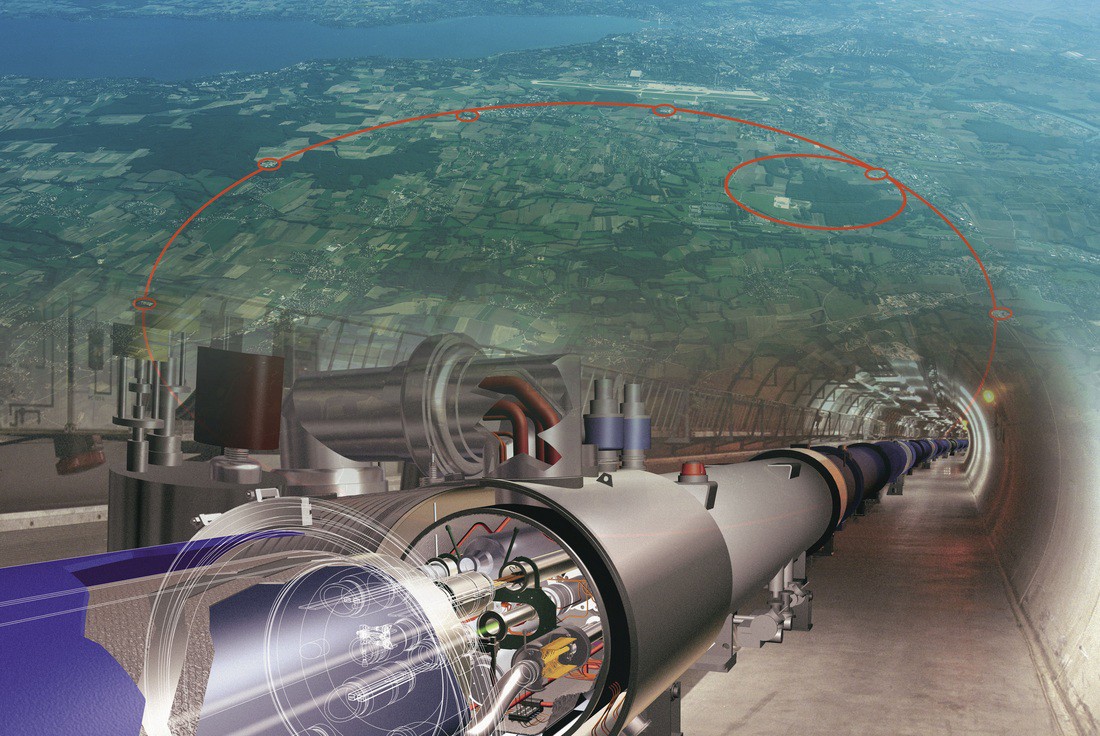
the Standard Model - analysis of data from the Large Hadron Collider.
If the mechanism of electroweak symmetry breaking is not found at the
Tevatron it will certainly be found at the LHC.
The ATLAS experiment will
discover the physics responsible for the generation of mass and
hopefully uncover new particles that can explain the universe's dark
matter. ATLAS is now completing a second very successful year of data taking!
- Neutrino Physics - the MINOS experiment is seeking to
elucidate the nature of neutrino oscillations, with an extension
called MINOS+ planned for the future. The
NEMO experiment is
searching for neutrinoless double-beta decay, which is one of the
few methods to directly determine the mass of the neutrino and
to determine whether it is a Dirac or Majorana particle. The successor
to NEMO, called SuperNEMO, is under construction, including at UCL.
- Cosmic Ray Physics - the highest energy
collisions occur not in man-made particle accelerators, but when
extremely high-energy cosmic rays from outer space strike the Earth.
The ANITA experiment is
seeking to make the first observation of ultra-high energy cosmic ray
neutrinos using radio antennas in a balloon over Antarctica. We also
investigate novel techniques for the detection of such particles.
- QCD phenomenology - published data
from HERA and the Tevatron is being analysed to provide a precise QCD
framework for physics at the LHC and beyond. This includes the
determination of parton distribution functions and higher order
corrections which will be vital for any discovery at the LHC.
- Search for new physics and precision
measurements at the electroweak scale - the CDF experiment is presently
taking data at the world's highest energy collider, the Tevatron at
Fermilab in Chicago and is studying the top quark, the W boson, the
b-quark sector and searching for new physics.
- Precision measurements of new Physics beyond
the Standard model - preparations for a future e+e- linear
collider . While the LHC is expected to make significant
discoveries and shed light on how the forces unify, it will be
necessary to make further more precise measurements of any new
phenomena discovered at the LHC in order to provide a clearer, more
detailed picture.
Further details of the group's activities can be found from the link
at the left of the page.
Positions Available
This broad programme provides a rich variety of M.Sc. and Ph.D.
research topics, ranging from theoretical work and data analysis through
to R&D into future experiments, and presents the opportunity for
students to develop a wide range of skills.
Advanced High Energy Physics M.Sc.
UCL offers a unique Masters degree course with a focus on High
Energy Physics.
Click
here
for more details.
Ph.Ds in Particle Physics
We welcome applications for Ph.Ds commencing in October 2011.
Studentships are generally offered between January and May,
and we expect to hold the first interviews in mid-February 2011.
The earlier you contact us, the better your chances.
Details of how to apply and who to contact can be found
here .
Interdisciplinary Ph.Ds : "Origins"
UCL's Institute of Origins exists to promote world leading research in topics
related to the Origins and Evolution of the Universe. Ph.D. studentships
may be available starting in October 2011 (to be confirmed). For further details
and a list of potential research topics, look
here .
Next Steps
We welcome applications in any of these areas. Here are details of
how to apply .
Please note that it's very important to consider how your postgraduate
studies will be
funded .
Last Modified : 12:47:25 08 Nov 2011